
“Resplendent in her finery”
Sunday's meditation, Revelation 21, gave me a new sense of the New Jerusalem, namely as a place where we can dwell together with God

“Attacks without, and within”
I would think that this is a feeling common to pretty well all of us, the feeling of being 'let down' by someone we love or by someone we had admired and respected. Perhaps it was a matter of being overlooked or unappreciated or taken for granted. And then, occasionally, there can be something worse, namely the experience of actually being treated unfairly or betrayed or attacked. Both King David and Jesus knew these feelings, these experiences, all too well, and that is the substance of today's meditation. I hope you find it helpful.

“A determination that is worthy of imitation”
We have probably all come across children or teens who have decided to give up on something because they felt that they 'sucked' at it, because they felt that they couldn't do well at whatever endeavour it happened to be. This is sad because often those first attempts are not in the least any indication of how they might do if they 'stuck' at it.
And sad, to say, sometimes us adults fall prey to the same impulse. And, it is especially sad when this comes to things in the spiritual realm, whether it is in prayer, study of the Scriptures, ministering in some way or just following Jesus. We are all bound to flub it at times, bound to flub it in some way or other. To do so is 'only human after all': all the original twelve disciples certainly bear this out.
In today's psalm and meditation we find that David experienced something of this. There he freely admits that he has 'blown it' at times, and yet, even so, he is determined to try hard, to do his best to listen to God and do as He wants. To me, this is a wonderful example to all of us, something we should all imitate.

“A double-edged sword”
I never know just what the passage for the day will be, or what its theme will be, as I simply take whatever the Forward Day by Day author has chosen. That means that I do not pick my favourite passage, as I might otherwise do, and am forced to deal with a totally unexpected passage and theme.
Anyway, it is interesting, and worthy of note, that both yesterday and today's passages--or at least my meditations on them--both touched on the vital and essential partnership between us and God, the vital relationship that we need to have with Him. Whereas, in the busy and sometimes hectic pace of our lives, we might be inclined to forget about this, these meditations all us back. I hope you enjoy them.

“Consistency”
I never know just what the passage for the day will be, or what its theme will be, as I simply take whatever the Forward Day by Day author has chosen. That means that I do not pick my favourite passage, as I might otherwise do, and am forced to deal with a totally unexpected passage and theme.
Anyway, it is interesting, and worthy of note, that both today and tomorrow’s passages--or at least my meditations on them--both touched on the vital and essential partnership between us and God, the vital relationship that we need to have with Him. Whereas, in the busy and sometimes hectic pace of our lives, we might be inclined to forget about this, these meditations all us back. I hope you enjoy them.

“Influencers”
One of the most persistent lies of the enemy is that we, ordinary, run-of-the mill type Christians, cannot have much of an impact or influence in the world. And yet, Jesus tells us to be salt and light, both of which have an incredible influence on things. And, so we should be encouraged to consistently and faithfully live our lives as Christ commands, little knowing what impact that will make--and ultimately, just leaving that matter up to God. Hoping you have a great day.

“Hey, what are you saying? Do you really mean this?
This morning at breakfast I mentioned how I have difficulties with certain very familiar passages. It is not because I am necessarily wanting something new or exciting, but because I want God's 'word', His message, for today. Years ago I learned something about the Scriptures that certainly applies here. A Bible teacher explained that there are two Greek words translated as 'word' in the New Testament. There is the word 'logos', which is applied in two ways, to the written word and to incarnate Word, which is Jesus Christ. But there is another Greek word, 'rhema', which is a living word, a word that the Spirit takes and applies to you in particular. It is the kind of word that jumps out at you and says 'Hey, listen up. This what God wants to say to you today." This is the kind of word that I watch and wait for, the kind of word that I hope to encounter every single day. But, with familiar passages, such as today's passage (the Beatitudes), this can be difficult, because it is so very, very familiar.
Oddly enough, this 'word' for today did not actually come to me until almost the very end of my meditation. I really that neither the outcome, nor the pre-condition (being merciful, humble, pure, persecuted etc.) were really the point of the passage. Instead, the whole idea was that we should yearn to know Christ better, love Him more deeply and follow Him more faithfully--and everything else would just fall into place.

“Faithful, in life and in death”
With my most recent meditations, I am reminded just how very important our focus or perspective is to the normal functioning of our lives. Yesterday's meditation spoke of how our focus needs to be on heaven and heavenly things rather than on the earth and its seeming delights. And today's mediation underlined the need to remain strong in our faith regardless of what might be happening to us or around us.
Here I am reminded of what Malcolm Muggeridge said at Wycliffe Convocation the year that I graduated. He spoke of our lives as Christians as being like the pockets of resistance that existed in occupied Europe during the closing years of World War II. For many in the Resistance things often seemed to go from back to worse as the Nazis feverly tried to locate and destroy any pockets of resistance. Often it seemed quite hopeless, except for the reports from BBC that told them of the positive developments that were happening elsewhere. Muggerridge suggested that our Bibles are like those BBC reports; they remind us of what God has done, and is doing, and that should give us hope. Or put another way, it should give us a different focus or perspective, one that elevates us above what we are presently going through.
Anyway, I hope these meditations are helpful. Happy Mother's Day to all the mothers out there, and to all the women who have nurtured us and acted like mothers in our lives.

“A question of focus”
With my most recent meditations, I am reminded just how very important our focus or perspective is to the normal functioning of our lives. Today's meditation spoke of how our focus needs to be on heaven and heavenly things rather than on the earth and its seeming delights. And tomorrow's mediation underlined the need to remain strong in our faith regardless of what might be happening to us or around us.
Here I am reminded of what Malcolm Muggeridge said at Wycliffe Convocation the year that I graduated. He spoke of our lives as Christians as being like the pockets of resistance that existed in occupied Europe during the closing years of World War II. For many in the Resistance things often seemed to go from back to worse as the Nazis feverly tried to locate and destroy any pockets of resistance. Often it seemed quite hopeless, except for the reports from BBC that told them of the positive developments that were happening elsewhere. Muggerridge suggested that our Bibles are like those BBC reports; they remind us of what God has done, and is doing, and that should give us hope. Or put another way, it should give us a different focus or perspective, one that elevates us above what we are presently going through.
Anyway, I hope these meditations are helpful. Happy Mother's Day tomorrow to all the mothers out there, and to all the women who have nurtured us and acted like mothers in our lives.

“Encountering God”
As Christians, people who know and love the Lord Jesus, we have a remarkable privilege and opportunity. We can know and relate to God intimately and personally. From the stories of people who have converted from Islam to Christianity, I have heard how they never felt that they knew God or were loved by God. Furthermore, they could only 'hope' that they were saved or accepted by God, for their understanding was that they could only know for sure after they died--which is a bit late! And with Buddhism, which is basically a non-theistic religion, there isn't even a god as such, much less one that a person can relate to. But with Christianity, we can know for sure that we are loved, accepted, and forgiveness--simply because of the grace of God in Christ Jesus. We don't have to earn it or measure up; it is simply a gift from a loving God, a gift to accept or reject.
Today's passage and meditation touches on this whole matter of knowing God and how that occurs and is possible. It's a hard matter to pin down in words, but I hope that my meditation at least steers you in the direction of some useful thought.

“In our shoes”
A number of years ago, I was involved in a renewal program of the church, something called Cursillo (said Kir Seal Lo) and was often called upon to give a talk on 'Obstacles to Grace', which was actually about sin. (I used to joke that I was given that assignment because it was something that I was very familiar with). As part of that talk I would also talk about temptation and about the choices we have in life. It is something very human and common to all of us. Here I find it intensely refreshing and helpful to know that Jesus was also familiar with this' fact of life' and had to deal with it Himself. That is what today's passage and meditation are all about. I hope you enjoy them.

“Consequences”
The Scriptures are notable for 'telling it like it is', and though our modern world often likes to gloss over the existence of sin or else excuse it as 'not really being our fault', the Scriptures do no such thing. In fact, a little bit of digging into the Scriptures reveals that it is much more pervasive, much more widespread than we might initially think. For a confirmation class a number of years ago, I decided to look up the various Biblical synonyms for sin (plus their meanings) and was astounded: disobedience, transgression, iniquity, wrong-doing, rebellion, wickedness, to mention just a few. And even the main Greek word for 'sin' in the New Testament, hamartia, simply means 'to miss the mark.' So, really, doesn't this 'cover' all of us.
How thankful I am that God not only points out the existence of this sad reality, but also gives us a way out, a remedy for sin, in the life, death and resurrection of Jesus Christ. Thanks be to God for this incredible gift. We aren't 'stuck' in it, or with it.

“Some evocative images”
Both yesterday and today’s meditations put me in mind of a very real and relevant truth, namely that God is more than happy, more than willing, and more than capable of helping us when we need it. The sad truth is that we often refuse either to ask Him or to receive His help. We are like one of my sons who was apt to say when I tried to help him, "Daddy, me do it. Daddy, me do it." You see, stubbornness and independence run amuck in my family--like father, like son. Anyway, God is there, ready and waiting, if only we let Him. Have a great day.

“Willing to accept help?”
Both today and tomorrow’s meditations put me in mind of a very real and relevant truth, namely that God is more than happy, more than willing, and more than capable of helping us when we need it. The sad truth is that we often refuse either to ask Him or to receive His help. We are like one of my sons who was apt to say when I tried to help him, "Daddy, me do it. Daddy, me do it." You see, stubbornness and independence run amuck in my family--like father, like son. Anyway, God is there, ready and waiting, if only we let Him. Have a great day.

“The constant refrain of heaven”
I guess that it is pretty well inevitable that one's reading of anything--including, of course, the Holy Scriptures--will be coloured by events either taking place in one's own personal life or in the wider world around us. So, yesterday's reading from John where Jesus assured His disciples--and us--that He is fully aware and fully in control of what is taking place in our world, and today's reading from Revelation where all of creation is seen as praising God in spite of--to use the colourful phrase--'all hell is breaking loose', seem particularly appropriate, to me at least, where the television newscasts are often anything but encouraging or cheerful. To know that we have a Saviour who cares and who is entirely trustworthy is a great relief. Anyway, here are a couple of meditations to inspire you.
“Prepared for the worst”
I guess that it is pretty well inevitable that one's reading of anything--including, of course, the Holy Scriptures--will be coloured by events either taking place in one's own personal life or in the wider world around us. So, yesterday's reading from John where Jesus assured His disciples--and us--that He is fully aware and fully in control of what is taking place in our world, and today's reading from Revelation where all of creation is seen as praising God in spite of--to use the colourful phrase--'all hell is breaking loose', seem particularly appropriate, to me at least, where the television newscasts are often anything but encouraging or cheerful. To know that we have a Saviour who cares and who is entirely trustworthy is a great relief. Anyway, here are a couple of meditations to inspire you.

“Our daily bread”
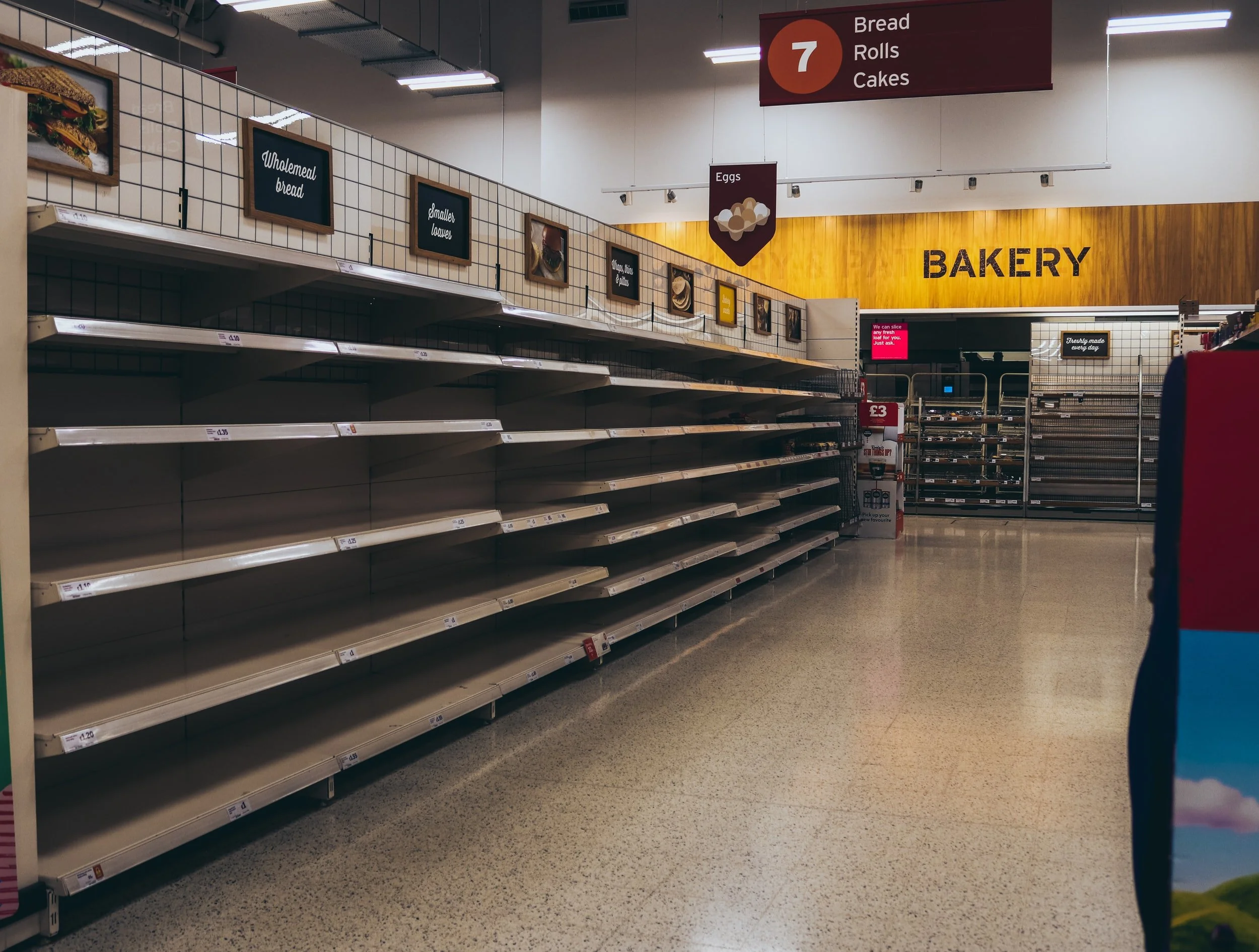
I'm afraid that most of us human beings are infected with two kinds of 'disease', one of them is worrying and the other is thinking that we have to do all of it ourselves, and both stem from the same root, namely of failing to trust fully in our Lord. And, in case we feel badly about this, we should know that Jesus was tempted with this very thing, the second one, when the devil tempted Him to change the stones into bread. In essence, He was being tempted to take matters into His own hands to feed Himself and others, rather than waiting upon God to do it.
Waiting upon God's provision: that was also one of the tests that the people of Israel faced in the wilderness. It is the theme of today's passage from Exodus. They were to obey and simply let God take care of everything else. And, as it was a test for them, so too is it a test for us today--and a matter of sincere and fervent prayer. So let me just leave it to you to work out, together with the Lord. My prayers are with you.

“A word for today?”
Today's passage strikes at an issue that has puzzled and worried sincere Christians for centuries. It is the question of civil disobedience, that is, whether it is ever right to disobey the orders of those in authority, and if so, how and when. Today's passage speaks of obeying an emperor, who just 'happened' to be one of the most corrupt, evil and downright nasty of all Roman emperors. And yet, elsewhere in the Scriptures we find clear cases of civil disobedience. For instance, the two Hebrew midwives in Egypt expressly disobeyed Pharaoh's orders when he was 'set' to eliminate the Hebrew people entirely (an ancient case of genocide). And Peter and John, when hauled up in front of the Sanhedrin and ordered to cease preaching, or even speaking, in the name of Jesus, told them that they had to obey God rather than human authorities. The Holy Scriptures do not seem to speak with one voice on the matter. And in the centuries since then, Christians have wrestled with the question. All perhaps that can be said for sure is that we need to listen to God on the matter, and await His particular 'word', His guidance, on whatever our specific situations happens to be. Anyway, that 's the best that I can do. Good luck with this question.

“If it’s not one thing, then it’s another”
I don't know whether I am alone in this, but of late I seem to be rather good at complaining, which I don't happen to think is a particularly good thing. It crowds out feelings of gratitude and thanksgiving and edges out any inclination to pray or to trust God. Yet, as we read in the Scriptures, this habit (of complaining) of epidemic and widespread. And so, we read that God, even in the midst of our complaining, does care, does listen and does act. But then, too, we do need to pray, and to trust Him and obey Him. Here's hoping that this day as been great so far

“Inarticulate prayers”
Years ago, at a clergy retreat, Sister Doreen of the Sisters of St. John the Divine suggested something that was very helpful to me. She suggested that we expand our thinking about what constitutes prayer. While we are accustomed to such 'organized' prayers as might begin with 'Dear God.." or such like, she suggested that those quiet, fleeting, spontaneously 'thought prayers', prayers as short as 'God, help', are equally as valid and equally as legitimate as forms of prayer--those spontaneous prayers that we utter silently when stopped at a stoplight or facing blizzard conditions on the highway or being appraised of a health crisis in someone's life. I found that suggestion to be very helpful and refreshing, as I do not always find myself down on my hands and knees, formal kind of prayers, especially when there is some sort of crisis.
Today's psalm and meditation suggested to me an even wider perspective on prayer, namely that it doesn't always have to even consist of words, that it can be an inner moaning or groaning, or an unuttered prayer of the heart. Jesus had counseled His disciples to always continue in prayer, and so too did the apostle Paul. Here, then, is just another way of doing so. Hope you have a great day.